Wednesday, June 15, 2011
Dinosaurs Roaming the Peace
Big! Awesome! Scary! Cool!
These are all words that are often used to describe dinosaurs. Who doesn’t love the idea that over 65 million years ago, there were dinosaurs running around in our very own province? We even have a dinosaur named after our province, the Albertosaurus. We, at the museum, certainly think it’s cool. We didn’t know until just a few short months ago, that in our collection is a partial tooth from an Albertosaurus.
Also in our collection are a vertebra of a hadrosaur tail (backbone), two ichthyosaur vertebrae (marine reptile backbones), ammonites, baculites, coral, brachiopod shells, bison bones, a mammoth molar, and many more.
To help us learn more about the exciting field of paleontology, Grande Prairie Regional College (GPRC) is coming up to Peace River on Thursday, June 16th, 2011 for a Fossil Roadshow, complete with school presentations, public drop-in times, and a public presentation.
Come and join the museum in learning about dinosaurs and fossils from Katalin Ormay and Robin Sissons, paleontologists from GPRC on Thursday, June 16th, 2011 at the Athabasca Hall. Public drop-in sessions are from 11:45 AM – 12:45 PM and from 3:00 – 6:00 PM. At 7:30 PM is the public presentation.
Labels:
Dinosaurs,
Museum Events
Thursday, June 9, 2011
16th Annual Aboriginal Gathering and Pow Wow
This weekend (June 11th and 12th) is the 16th Annual Aboriginal Gathering and Pow Wow at the Peace River Ag Grounds (NOTE: new location from previous years). For more information, please see the Aboriginal Interagency Committee website for more schedules, directions, etiquette information and other details.
Labels:
Community Events,
First Nations,
Pow Wow
Tuesday, June 7, 2011
Heritage on the run – a way to perpetuate our past
Fourteen years ago this June, the Peace River Running Club changed the name and the beneficiary of its annual race.
Routes, running surfaces and people have changed. One thing has not – the running club’s commitment to a healthy fund-raising endeavour to benefit our community. In 1997, the Museum and the Peace River Running Club teamed to present the Peace River Heritage Run, the successor to the previous summer’s Run in Peace 10K. As race director Patrick Mackenzie said in a 1997 news release – “[It] will not only provide a recreational and competitive opportunity for runners from near and far, it will also raise money for, and awareness of, the Museum. The Peace River Heritage Run brings together two important aspects of life.”
Museum Director Laura Gloor knows first-hand the value of the Heritage Run. “The museum has been a most appreciative annual beneficiary of the physical and financial efforts of the PRRC organizers and the runners and walkers since 1997. These sizeable donations have purchased exhibit cases, Ken Ayre of Ayre Loom wooden furniture, a research table and most recently, contributed almost $3,000 towards our new, compact, mobile shelving in the Diane Gayton Collections Room. Combining Heritage and Health is beneficial in so many ways.”
The Heritage Run, Sunday, June 12, this year is comprised of a half marathon, 10km individual run, 5km individual run, 5X2km relay and 5km walk. Start times are not quite as early as in previous years to allow out-of-town participants an opportunity to attend. “We hope this allows for an increase in the number of participants,” says Frits Dijk, race director. The half marathon begins at 9:30 a.m., while other distances commence at 10 a.m. – all from just south of the Museum. Entry forms may be obtained by going to the Peace River Running Club’s Heritage Run website or from Marian Craig: sunshine@wispernet.com or Ken Wurst: Ken.Wurst@hotmail.com
Dijk urges race-day entrants to arrive in plenty of time to register.
Routes, running surfaces and people have changed. One thing has not – the running club’s commitment to a healthy fund-raising endeavour to benefit our community. In 1997, the Museum and the Peace River Running Club teamed to present the Peace River Heritage Run, the successor to the previous summer’s Run in Peace 10K. As race director Patrick Mackenzie said in a 1997 news release – “[It] will not only provide a recreational and competitive opportunity for runners from near and far, it will also raise money for, and awareness of, the Museum. The Peace River Heritage Run brings together two important aspects of life.”
Museum Director Laura Gloor knows first-hand the value of the Heritage Run. “The museum has been a most appreciative annual beneficiary of the physical and financial efforts of the PRRC organizers and the runners and walkers since 1997. These sizeable donations have purchased exhibit cases, Ken Ayre of Ayre Loom wooden furniture, a research table and most recently, contributed almost $3,000 towards our new, compact, mobile shelving in the Diane Gayton Collections Room. Combining Heritage and Health is beneficial in so many ways.”
The Heritage Run, Sunday, June 12, this year is comprised of a half marathon, 10km individual run, 5km individual run, 5X2km relay and 5km walk. Start times are not quite as early as in previous years to allow out-of-town participants an opportunity to attend. “We hope this allows for an increase in the number of participants,” says Frits Dijk, race director. The half marathon begins at 9:30 a.m., while other distances commence at 10 a.m. – all from just south of the Museum. Entry forms may be obtained by going to the Peace River Running Club’s Heritage Run website or from Marian Craig: sunshine@wispernet.com or Ken Wurst: Ken.Wurst@hotmail.com
Dijk urges race-day entrants to arrive in plenty of time to register.
Labels:
Community Events,
Heritage Run,
Museum Events
Thursday, June 2, 2011
York Boat arrives on the Peace Once Again!
It is an historic event! For the first time in over a century, a York boat will be navigating the Peace River!
Our river was a major route for Canada’s fur trade from the late 1700s to the late 1800s. Trade goods, furs and people plied the water of the Peace in canoes and flat bottomed scows until the arrival of the York boat. The design was commonly associated with the fur trade empire of the Hudson’s Bay Company (HBC). It came with the rugged Scottish men of the Orkney Islands who brought their seafaring hardiness, along with the boat design, to the HBC. At 3000 pounds and 33 feet long, the freighting capacity of the Hudson’s Bay Company was greatly improved, thus providing a competitive edge to their intense rivalry with the North West Company.
GeoTourism comissioned this historic watercraft to be rebuilt and with Flow North Paddling is recreating a trip from Ft. Dunvegan to Ft. Vermilion. To see photographs of the building of the boat, please visit the GeoTourism website. The York boat was blessed by Dave Cummings of Fairview and given a grand send off from Fort Dunvegan Park on June 1st. To follow its progress, visit the GeoTourism facebook page.
The boat is scheduled to overnight at Strong Creek Campground June 3rd and to arrive at Riverfront Park at midday June 4th.
There will be a pancake breakfast at Strong Creek Campground at 9 am, June 4th. Everyone is welcome to enjoy some delicious pancakes by Grimshaw High School and witness the launch of the York boat.
At around 1 pm, the Town of Peace River will give a hearty welcome to the boat and the crew at Riverfront Park. Enjoy the performances that will highlight the cultures of the First Nations, Métis Scottish and Francophone people who inhabited the land along the river one hundred years ago. Dress in your best Twelve Foot Davis outfit or your best trapper gear for prizes to summer events like Peacefest and the North Peace Stampede!
Following the departure of the York boat, the band C.Alice will take to the stage to launch the first of the summer Concert in the Park Series, sponsored by the Town of Peace River and Northern Sunrise County.
We would also like to let our community know that it is a weekend full of events and we hope you will be out taking in as much as you can. Along with the York boat's arrival, the Peace River Art Club and The Social are hosting the "Arts in the Hall" event all weekend with art, concert and workshops.
Our river was a major route for Canada’s fur trade from the late 1700s to the late 1800s. Trade goods, furs and people plied the water of the Peace in canoes and flat bottomed scows until the arrival of the York boat. The design was commonly associated with the fur trade empire of the Hudson’s Bay Company (HBC). It came with the rugged Scottish men of the Orkney Islands who brought their seafaring hardiness, along with the boat design, to the HBC. At 3000 pounds and 33 feet long, the freighting capacity of the Hudson’s Bay Company was greatly improved, thus providing a competitive edge to their intense rivalry with the North West Company.
GeoTourism comissioned this historic watercraft to be rebuilt and with Flow North Paddling is recreating a trip from Ft. Dunvegan to Ft. Vermilion. To see photographs of the building of the boat, please visit the GeoTourism website. The York boat was blessed by Dave Cummings of Fairview and given a grand send off from Fort Dunvegan Park on June 1st. To follow its progress, visit the GeoTourism facebook page.
The boat is scheduled to overnight at Strong Creek Campground June 3rd and to arrive at Riverfront Park at midday June 4th.
There will be a pancake breakfast at Strong Creek Campground at 9 am, June 4th. Everyone is welcome to enjoy some delicious pancakes by Grimshaw High School and witness the launch of the York boat.
At around 1 pm, the Town of Peace River will give a hearty welcome to the boat and the crew at Riverfront Park. Enjoy the performances that will highlight the cultures of the First Nations, Métis Scottish and Francophone people who inhabited the land along the river one hundred years ago. Dress in your best Twelve Foot Davis outfit or your best trapper gear for prizes to summer events like Peacefest and the North Peace Stampede!
Following the departure of the York boat, the band C.Alice will take to the stage to launch the first of the summer Concert in the Park Series, sponsored by the Town of Peace River and Northern Sunrise County.
We would also like to let our community know that it is a weekend full of events and we hope you will be out taking in as much as you can. Along with the York boat's arrival, the Peace River Art Club and The Social are hosting the "Arts in the Hall" event all weekend with art, concert and workshops.
Saturday, May 28, 2011
Dinosaurs at Peace River Museum
Let’s compare teeth … Yup, teeth!
Take a look at the picture below and take a guess as to which is a dinosaur tooth and which is a mammoth tooth.
If you guessed dinosaur for the small tooth and mammoth for the large tooth, you’re right!
The small, partial tooth is from an Albertosaurus, a meat-eater that looked a lot like a Tyrannosaurus rex, just a bit smaller and lived during the cretaceous period. Albertosaurus was about 8-9 metres long, 3 metres tall at the hip and weighed up to 3 tonnes. It had short arms with two-fingered hands and long powerful back legs with three-toed feet for speed and agility. The “Alberta Lizard” was first discovered in 1884 by J.B. Tyrrell along the Red Deer River in Alberta.
This Albertosaurus tooth may look small but it would have been razor-sharp 75 million years ago, perfect for tearing flesh.
Contrary to the “Alberta Lizard”, the mammoth was a grazing plant-eater that fed mostly on grasses. They were ancestors to but larger than the modern Asian elephant. They lived during the Pleistocene era, also known as the American Ice Age and died out at the end of the Ice Age, about 10,000 years ago. They were about 5 metres long, up to 4 metres tall at the shoulder and weighed up to 3 tonnes. Their pointed, curved tusks could be up to 5 metres long, though they usually ranged from 3-3.7metres long.
With how large the mammoths were, they would have spent up to 20 hours a day grazing for food. In that case, it’s fortunate that the mammoths teeth were composed of layers of compressed enamel plates, held together with cementum. This composition made them very strong and resistant to wear, since eating grass is a hard thing to do and really wears at the teeth.
Come and join us to learn more about palaeontology, the study of fossils from past ages, on Thursday, June 16th, 2011. Robin Sissons and Katalin Ormay, palaeontologists from Grande Prairie Regional College will be with us at Athabasca Hall from 12 noon – 1 PM and 3 – 6 PM for public drop in sessions and again at 7:30 PM for a public presentation on Northwest Alberta Palaeontology.
Take a look at the picture below and take a guess as to which is a dinosaur tooth and which is a mammoth tooth.
The small, partial tooth is from an Albertosaurus, a meat-eater that looked a lot like a Tyrannosaurus rex, just a bit smaller and lived during the cretaceous period. Albertosaurus was about 8-9 metres long, 3 metres tall at the hip and weighed up to 3 tonnes. It had short arms with two-fingered hands and long powerful back legs with three-toed feet for speed and agility. The “Alberta Lizard” was first discovered in 1884 by J.B. Tyrrell along the Red Deer River in Alberta.
This Albertosaurus tooth may look small but it would have been razor-sharp 75 million years ago, perfect for tearing flesh.
Contrary to the “Alberta Lizard”, the mammoth was a grazing plant-eater that fed mostly on grasses. They were ancestors to but larger than the modern Asian elephant. They lived during the Pleistocene era, also known as the American Ice Age and died out at the end of the Ice Age, about 10,000 years ago. They were about 5 metres long, up to 4 metres tall at the shoulder and weighed up to 3 tonnes. Their pointed, curved tusks could be up to 5 metres long, though they usually ranged from 3-3.7metres long.
With how large the mammoths were, they would have spent up to 20 hours a day grazing for food. In that case, it’s fortunate that the mammoths teeth were composed of layers of compressed enamel plates, held together with cementum. This composition made them very strong and resistant to wear, since eating grass is a hard thing to do and really wears at the teeth.
Come and join us to learn more about palaeontology, the study of fossils from past ages, on Thursday, June 16th, 2011. Robin Sissons and Katalin Ormay, palaeontologists from Grande Prairie Regional College will be with us at Athabasca Hall from 12 noon – 1 PM and 3 – 6 PM for public drop in sessions and again at 7:30 PM for a public presentation on Northwest Alberta Palaeontology.
Labels:
Dinosaurs,
Museum Events
Friday, May 20, 2011
An Afternoon of Chinese Tea event
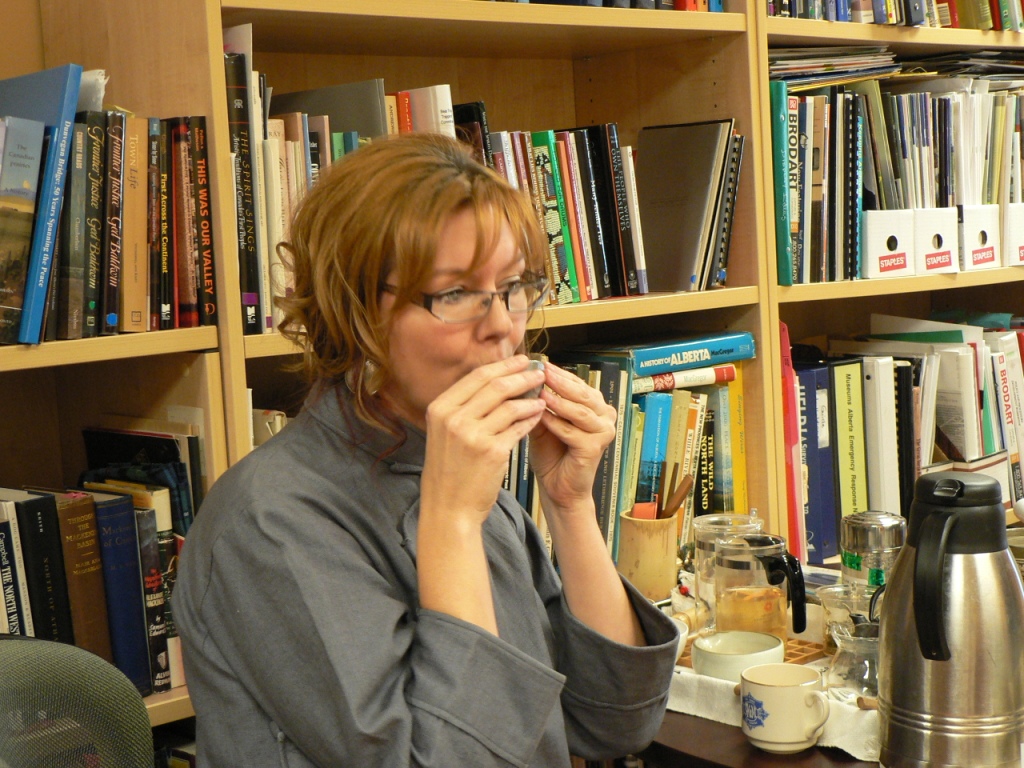
Thank you to all who attended the Afternoon of Chinese Tea. It was a lovely event filled with a great variety of teas, not only from China, but from a few from Korea and Japan as well. Thank you also to Wend Wagner, of ZenSpa, for bringing her knowledge about the history and culture of tea and her tasty teas.
Here are some photographs from the event:
![]() |
| Wend Wagner, our hostess, demonstrating the proper way to sip tea. |
![]() |
| Sonia Rosychuck tests dungulaecha, a Korean tea, which was served cold and used to refresh our palettes in between teas. |
![]() |
| The tea table! |
![]() |
| A few of our attendees learning about teas. |
Labels:
Chinese,
Exhibits,
Museum Events
Wednesday, May 11, 2011
An Afternoon of Chinese Tea
In conjunction with our current exhibit, "Chop Suey on the Prairies: A Reflection of Chinese Restaurants in Alberta", we will be hosting An Afternoon of Chinese Tea. On Saturday, May 14th, from 3:30 to 5:30 pm, Wend Wagner, from ZenSpa, will be at the Peace River Museum, Archives and Mackenzie Centre to speak to the art of drinking and serving tea in China. She will offer taste testing of teas from China, as well as Korea and Japan.
The Chop Suey on the Prairies exhibit will run only until the end of May, but will be on display at Lac Cardinal Regional Pioneer Museum for the month of June.
Labels:
Chinese,
Exhibits,
Museum Events
Friday, May 6, 2011
The International Year of the Forest reflected in Art
For the month of May, in honour of International Year of the Forest and Alberta Forestry Week (May 1 - 7), the Museum's art wall is a dedicated our boreal forest. Contributing artists are: Sonia Rosychuck, Wend Wagner, Rhonda Warren, Trudy Plaizier, Diane Spirig and Marie Laventure.
And just a reminder, there is no admission to see the Peace River Museum Art Wall, and general admission to the Museum is $2 per person.
Labels:
Artists of the Peace,
Exhibits,
Forestry
Thursday, May 5, 2011
Results of the Unchaga Run
The Fourth Annual Unchaga Run took place on Shaftesbury Trail on May 1st. There were 154 runners. The top three winners each division were:
5K:
1. Zachary Billard, 22:21.67
2. Andrea Taylor, 25:48.14
3. Liam McCracken, 28:02.28
10k:
1. Brandon Duvall, 39:40.89
2. Ken Wurst, 42:02.14
3. Tammy Burrows, 42:14.05
20k:
1. Joe Larsback, 1:37:30.25
2. Laverna Hards, 1:51:51.08
3. Toni Craig, 1:55:28.09
And here are our runners, preparing to set off!
An estimated $2500 dollars was raised for the Peace Regional Outreach Campus. Seen below is Stacy Parsons (left), the organizer of the Unchaga Run, presenting a cheque to Outreach staff: Dave Matilpi and Carol vanSlyke and Peace River School Division #10 trustee, Louise Woroniuk.
The following volunteers are sincerely appreciated for their help in this event: Lorri, Kevin, Kayla, Ed, Mike, Stacy and Cal. Also, a special thank you goes out to Dave Matilpi for the Blessing.
Sponsors for the event were: InVision Chartered Accountants, Grande Prairie Run and Walk Club, Peace River Running Club, River Rock Restaurant, Peace Safety and Environment Training Ltd., Town of Peace River, Tim Horton's and Wolves Athletic Club.
Labels:
Community Events,
Unchaga Run
Subscribe to:
Posts (Atom)